











Caring for Your Printed Products
How your clients display and store their products matters. Here's what to know about light, heat, humidity, and care across every print method we offer to help your work look its best for generations.
Your WHCC products are made with professional-grade materials and built to be passed down for generations. How and where you display and store them plays a real role in how long they stay looking their best. A little care goes a long way.
What Affects Print Longevity
All printed images are affected by the same environmental factors regardless of process or substrate. The degree of impact varies by product, but the principles are universal.
Light. This is the big one. Ultraviolet (UV) radiation from sunlight, fluorescent bulbs, and halogen lighting breaks down the chemical compounds that produce color in inks and dyes. The more intense the light and the longer the exposure, the faster fading happens. Even indirect sunlight adds up over the years. The good news: with thoughtful placement, your prints can look beautiful on the wall and be passed down for generations.
Heat. Warmth speeds up the chemical reactions behind fading and material breakdown. Stable, cool environments are easier on prints than rooms with big temperature swings.
Humidity. High humidity encourages mold and can cause papers and substrates to warp, stick, or degrade. Very low humidity can make paper brittle. Consistency matters most. Steady conditions are better than a perfect number that fluctuates throughout the day or across seasons.
Airborne pollutants. Ozone and other pollutants can contribute to gradual color shifts, especially on prints displayed without protective coatings or glazing.
Display & Care by Print Method
WHCC products span several printing technologies, each with its own characteristics when it comes to longevity and care. Below, we've organized recommendations by print method, with notes on which products use each.
Silver Halide (Photographic Prints)
Products: Photographic Prints (loose and mounted), Albums, Layflat Books
Our silver halide prints are produced on Fujicolor Crystal Archive papers, a true photographic process with no ink involved. Silver halide crystals and color-forming dye couplers create the image, delivering excellent color stability built to last for generations. These papers have earned top marks in independent longevity testing by Wilhelm Imaging Research, with over 100 years of display life under typical conditions and over 200 years in dark storage.
Display recommendations:
- Hang on interior walls away from direct sunlight. Hallways, bedrooms, and interior rooms are great choices because they tend to get less cumulative light than living areas with large windows.
- Our lustre coatings, protective laminates, and print textures aren't just about the look. They add a physical barrier that helps guard against fingerprints, moisture, and surface wear while extending display life.
- Keep prints away from heat sources like radiators, fireplaces, and south-facing windows without UV film. High-humidity spaces like unventilated bathrooms aren't ideal either.
Albums & Layflat Books:
- Store upright on a shelf or flat. Never at an angle, which can shift pages and warp spines over time.
- A cool, dry spot away from light is all you need. Typical indoor conditions work well, roughly 65–75°F and 30–60% relative humidity. Consistency matters more than precision.
- Open gently and support both covers. Handle pages by the edges rather than touching the printed surface.
- For long-term storage, a closet shelf is ideal. Avoid attics, garages, basements, or anywhere with wide temperature and humidity swings. Sealed plastic bins in non-climate-controlled spaces can trap moisture and should be avoided.
Pigment Inkjet (Fine Art Prints & Canvas)
Products: Fine Art Prints (loose and mounted), Gallery Wraps, Portrait Canvas, Canvas Prints
Fine Art Prints and Canvas products use pigment-based inkjet inks, known for outstanding lightfastness. Pigment inks resist fading from light exposure far better than dye-based inks. Canvas products also receive a protective laminate (semi-gloss or matte) that adds UV and moisture resistance. With proper care, these products will hold their color and detail for generations.
Display recommendations:
- Interior walls away from direct sunlight, same as photographic prints.
- Fine art prints on paper don't have a built-in protective surface, so framing is recommended for anything on long-term display (see Framing & Acrylic Glazing below).
- The laminate on canvas products does a lot of the heavy lifting on protection, but thoughtful placement still matters. Dust canvas gently with a soft, dry cloth and avoid using liquid cleaners on the surface.
- Avoid direct sunlight, high-humidity areas, and rooms with significant temperature swings. Very dry conditions can make canvas taut and brittle; very humid conditions can make it sag or encourage mold.
- Handle fine art papers with clean, dry hands and avoid touching the printed surface.
Framing & Acrylic Glazing
Products: Framed Prints, Float Frames
Framing is one of the most effective ways to extend the display life of any paper-based print. A frame with acrylic glazing creates a barrier between the print and its environment, protecting against dust, moisture, handling, and pollutants.
We offer two optional acrylic glazing upgrades. Our standard acrylic provides inherent UV filtering, and our glare-resistant acrylic blocks up to 99% of UV rays. That's a significant reduction in the wavelengths most responsible for fading. For prints going in rooms with a lot of natural light, acrylic glazing is one of the best investments you can make in keeping your work looking its best for the long haul.
Even with UV-protective acrylic, keeping frames out of direct sunlight helps. Acrylic glazing slows fading dramatically, but it doesn't stop all light from doing its work over many years.
Dye Sublimation on Aluminum (Metal Prints)
Products: Metal Prints, Exterior Metal Prints
Metal Prints are produced on ChromaLuxe aluminum panels using dye sublimation. Heat and pressure infuse the image permanently into a specialized polymer coating on the metal surface. ChromaLuxe panels have been tested by Wilhelm Imaging Research and have achieved some of the highest display permanence ratings in the industry. These are built to last.
Display recommendations:
- No glazing needed. The image is sealed within the coating, so metal prints resist moisture, surface abrasion, and atmospheric pollutants right out of the box.
- Metal prints are among the most durable display products we offer. They do well in bright rooms, commercial spaces, and even humid environments like bathrooms. They'll hold their brilliance longest when kept out of sustained, direct sunlight, but they can handle more light exposure than paper-based products.
- Clean with a soft, damp microfiber cloth. A non-ammonia household cleaner works for stubborn marks. Avoid abrasive cleaners, metal polishes, or rough cloths.
- Standard (indoor) Metal Prints aren't designed for permanent outdoor or direct-sunlight display. Our Exterior Metal Prints are engineered specifically for that with enhanced UV resistance.
Digital Press (HP Indigo)
Products: Hardcover Books, Softcover Books, Flat Cards, Folded Cards, Promotional Cards, Business Cards
Our press-printed products are produced on HP Indigo digital presses using a liquid electrophotographic process (sometimes called digital offset) that delivers sharp, vibrant color on coated paper stocks. These prints hold up well to everyday handling, but like all paper-based products they benefit from a little care.
Cards on display:
- If framing a card, follow the same placement guidance as other paper prints: interior wall, away from direct sunlight, and consider acrylic glazing for long-term display.
- Unframed cards on a mantel or shelf will be more exposed to light and environmental factors. Rotating what's out or keeping them away from direct light helps them stay vibrant.
Hardcover & Softcover Books:
- Store upright or flat, never at an angle. A cool, dry spot away from direct light is all you need.
- Same temperature and humidity guidance as albums: roughly 65–75°F, 30–60% relative humidity, with consistency being more important than precision. Avoid attics, garages, basements, and other non-climate-controlled spaces.
- Handle with clean, dry hands. Be gentle when sliding books on and off shelves to avoid scuffing covers.
Acrylic Prints
Products: Acrylic Prints, Acrylic Blocks
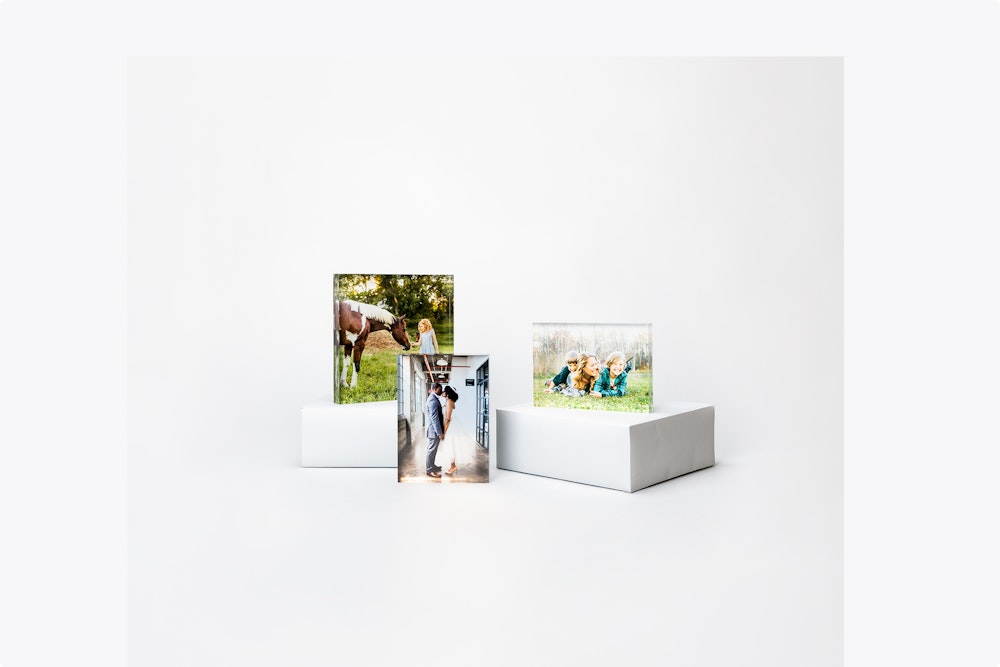
Acrylic Prints are produced by face-mounting a fine art quality print to the back of ¼" acrylic. The acrylic layer provides UV filtering and physical protection for the image, and the result is a stunning, modern display built to look great for decades.
Display recommendations:
- Hang on interior walls, ideally away from sustained direct sunlight. The acrylic adds real protection, but prolonged direct sun will still cause gradual shifts over a long period.
- Keep away from high heat. Acrylic can warp or soften in extreme warmth, so avoid placement above fireplaces, in uncontrolled sunrooms, or in direct contact with hot light fixtures.
- Clean with a soft microfiber cloth, slightly damp if needed. Avoid ammonia-based cleaners and anything abrasive that could scratch the surface.
Wood Prints
Products: Wood Prints
Wood Prints feature your image printed directly onto solid maple. The natural grain shows through and is part of the charm, but it also means these products are a bit more responsive to their environment than metal or acrylic.
Display recommendations:
- Hang on interior walls, away from direct sunlight and moisture.
- Wood is hygroscopic, meaning it naturally absorbs and releases moisture from the air. Significant humidity swings can cause subtle warping or movement in the substrate. A stable indoor environment keeps things looking great for the long run.
Mounted Display Products
Products: Standouts, Float Wraps, Bamboo Panels
Standouts, Float Wraps, and Bamboo Panels feature photographic or fine art prints mounted to a rigid substrate with finished edges. Care recommendations follow the print surface used. See the Silver Halide or Pigment Inkjet sections above and apply the same principles. Bamboo Panels have natural bamboo along the exposed edges, which responds to humidity much like wood, so a stable indoor environment is best.
General Best Practices
For products on display:
- Interior walls away from direct sunlight are your best bet. North-facing walls and interior hallways are great spots.
- In rooms with lots of natural light, UV-filtering window films help protect everything in the room, not just your prints.
- Use LED lighting to illuminate your work. Unlike fluorescent and halogen bulbs, LEDs produce virtually no UV radiation.
- Consider rotating what you have on display. Giving pieces some rest time in lower-light conditions extends their life even further.
For products in storage:
- Cool, dry, and dark. Interior closets and bedroom shelves beat attics, basements, and garages every time.
- Keep everything off the ground in case of water.
- Don't stack heavy items on top of prints, albums, or books.
A Note on Longevity
Print longevity ratings, like those from Wilhelm Imaging Research, come from standardized accelerated aging tests under controlled lab conditions. They simulate typical indoor display at moderate light levels with standard temperature and humidity to estimate when noticeable fading would first appear.
These ratings reflect the quality of the materials in your WHCC products, and they're impressive. But real-world results depend on real-world conditions. A print in a dimly lit hallway will stay vibrant much longer than the same print on a sun-drenched wall. Neither scenario means your print won't last. It's about how long it looks its absolute best.
We use some of the finest materials in the industry, built to last for generations. How long they look their best is a partnership between the quality we build in and the care on the other end.